

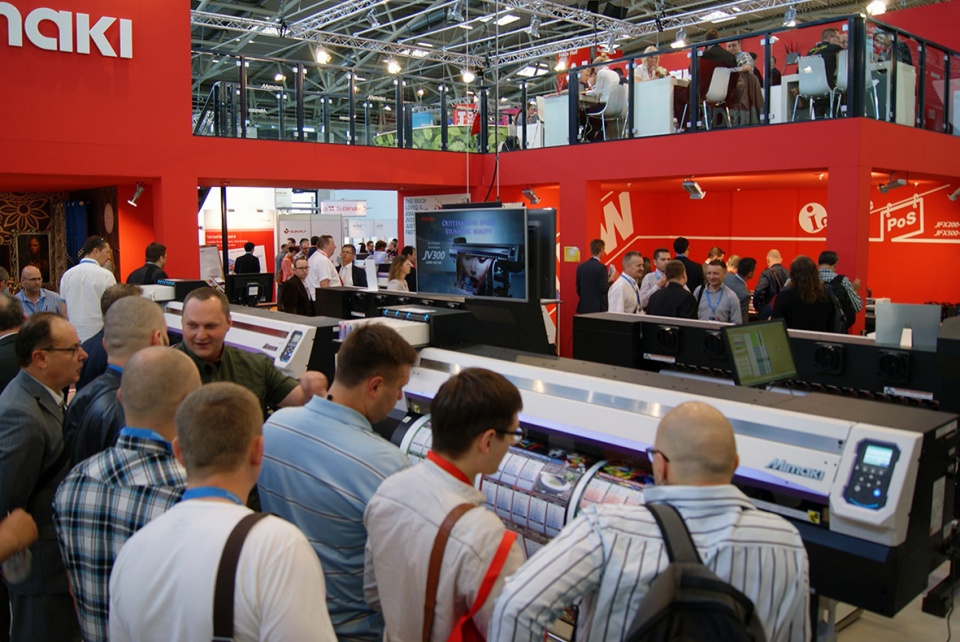
Metaprintart meet Mike Horsten, General Manager Marketing EMEA, Mimaki Europe to focalize the market evolution and trend of digital inket printing.
MetaPrintArt – Inkjet printing has its origin in prototypes presented at drupa 1995, and at that time quality was not good. After almost 20 years we can say that inkjet printing is well spread and accepted, not only because of its quality but also for the wide range of applications. However, today there is still the tendency to identify inkjet with wide format and consequently with printing for visual communication. Which are the reasons of this attitude?
 Mike Horsten – First of all, the first inkjet printers where already shown in Europe in the early 90’s. We are now almost 15 years into this industry. The visual communications industry was the first to adopt this technology, as there was a need to make specials and one-offs. The other options like silkscreen and analog photographic imaging, were very expensive, in comparison with the new digital solutions like inkjet and electrostatic printing. As electrostatic printing was more expensive and required extra finishing, the choice for easy to use cheap large format printing products based on inkjet became the standard. Purely based on key benefits of ease of use and production cost, inkjet quickly became the default for visual communications.
MPA – Another strong developing field is the one of label and packaging printing, above all thanks to UV inks and varnishes. Which is the position of Mimaki regarding this issue?
M. H. – We believe packaging will be the next big step in the digitalization of the print industry. The traditional runs for packaging have been always very big, with digital printing you can now print shorter runs, personalize them and print on demand what you need today. In the prestige market segments the quantities of packaging and the complexity of the markets have only made digital printing more attractive. Now you can print a cosmetics box in high quality, personalize it and still include foil for the gold and silver extras. Even the possibility of adding a hologram is possible. Mimaki has developed together with Digi-Foil a complete sample print-station just for this purpose. We can even print on round bottles, so the options are endless.
MPA – If we consider commercial printing, that is products that are printed in offset, which are the perspectives of inkjet? The speed and cost of the inks are a limit, and until this will be a limit?
M. H. – The actual limit of inkjet today is the speed. With commercial printing, like web offset and other web press technologies like roto gravure, the inkjet printing of today is just too slow. We will see more developments in the future as inkjet technology matures and heads gain faster output ratio’s. The question today is can inkjet replace traditional print? The answer to that question is simple: not today.
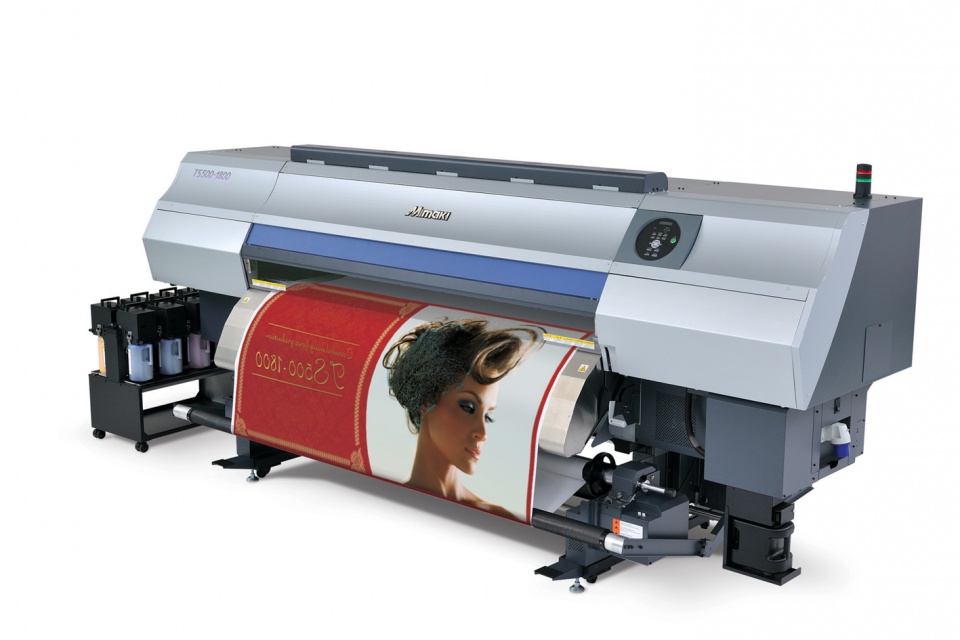
Mimaki TS500 1800 diagonal
MPA – Among the application that spread in recent times, textile printing is very interesting. Some manufacturing companies are textile oriented. What is the position of Mimaki? Which are the advantages in comparison with transfer printing and the perspectives?
M. H. – The production of textiles via digital print has made it possible to bring back textile printing to Europe. Textile printing has been a very big growth market for Mimaki not only in Turkey, where it started, but also in Europe. The option to print directly to the fabric or via transfer paper is solely a choice of what market the textile producer is working in.
The garment and sportswear industries mostly use dye-sublimation transfer printing: this is because of the higher quality and the higher production speeds that are possible with transfer paper.
The fashion industries on the other hand use other materials and rather frequently fabrics with natural fibers, so reactive and acid inks are used in a direct print manner. The advantage of direct print is that you can see exactly how much you need to produce and consequently produce it right away, change the colours on the fly. Plus, there is little to no waste production. In the traditional way you would have needed at least 7 screens to get a similar result without color changes.
MPA – Considering the concepts, you explained us, which are the most interesting markets today and at medium term for your solutions?
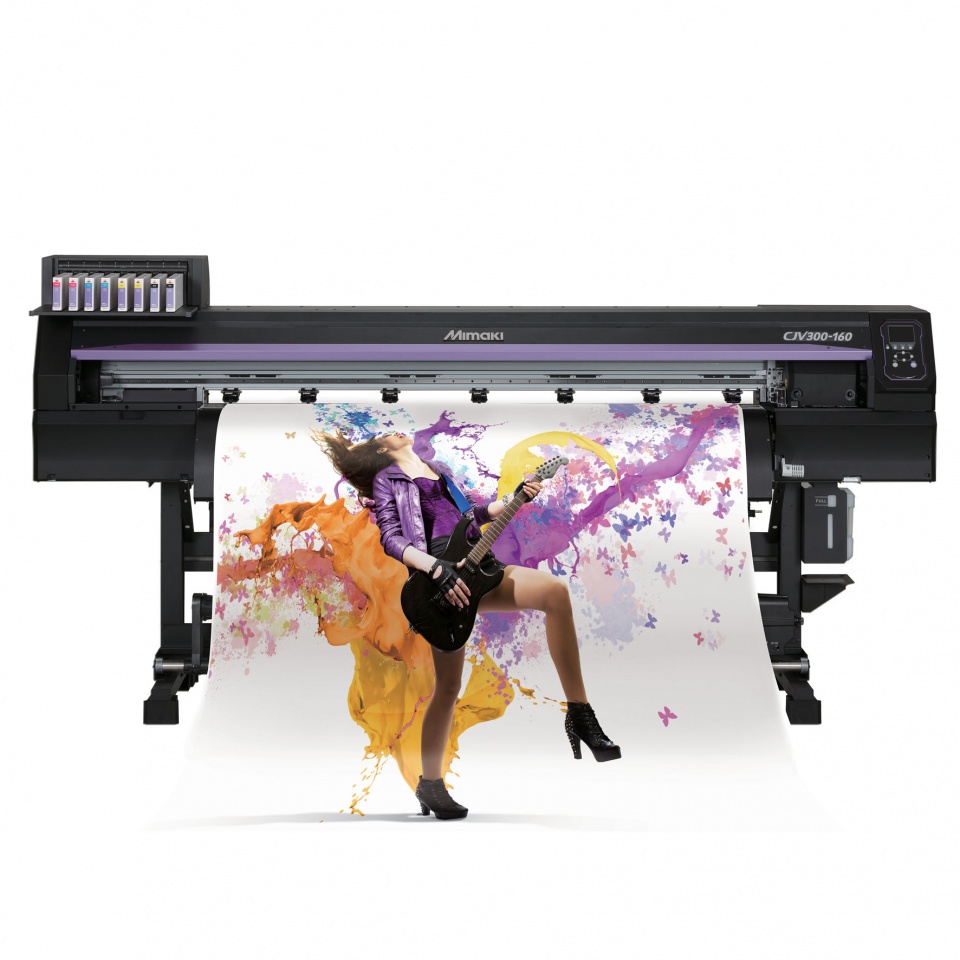
The new plotter Mimaki CJV300
M. H. – The most interesting are the textile and packaging print markets, the growth numbers in both of these markets are in the excess of 100% per year. With the addition of the speed of the new machines we now can easily compete with the East when it comes to the production of garments in Europe. We see large commercial retail chains working with digital print and producing them in Europe today.
As for the packaging we see that the high-end packaging with personalization is a growth market. This all really started with the “Share a Coke” campaign; people now want to have a personalized item, causing the whole bespoke market to be booming.









Leave A Comment